Google Ads for Medical Practices: A Healthcare PPC Playbook That Brings In Patients
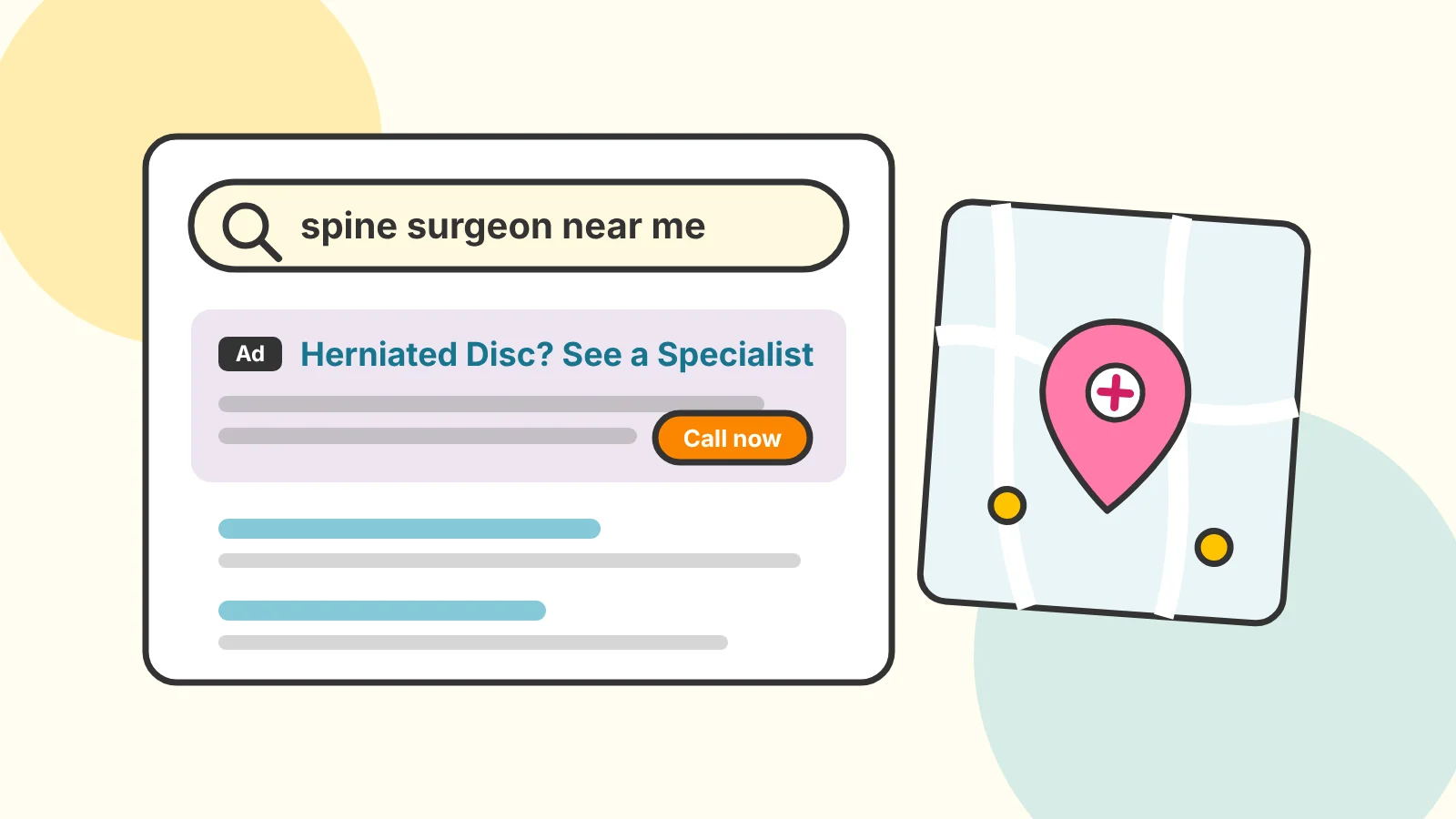
Patients don’t search for “healthcare.” They search for what hurts.
That one idea shapes everything about Google Ads for medical practices. Someone with a herniated disc isn’t typing “neurosurgery.” They’re typing their symptom, their diagnosis, or “spine surgeon near me,” usually on a phone, often worried. The practices that win in paid search are the ones whose ads match those searches exactly and whose pages answer the question that brought the patient there.
I manage paid search for healthcare practices, including a multi-location neurosurgical group in New Jersey and New York. Rebuilding that account around condition-specific, hyper-local intent helped produce 59 new patient cases and nearly 200% more form submissions in five months. Here’s the playbook.
TL;DR
- Build campaigns around conditions and procedures, not your specialty’s name.
- Go hyper-local: each office gets its own targeting and ads.
- Use match types with discipline: broad match without guardrails wastes healthcare budgets fast.
- Know the healthcare ad rules: no health-based remarketing, and some services need certification.
- Keep patient data out of your tracking. Bring compliance in early.
- Measure new patients, not clicks.
1. Build Campaigns Around Conditions, Not Specialties
A specialty name is how doctors think. Conditions and procedures are how patients search. For a spine practice, that means separate ad groups for things like herniated discs, spinal stenosis, sciatica and spinal fusion, each with keywords, ads and a landing page that speak to that condition.
This does two things. Your ads become far more relevant, which helps click-through rate and Quality Score. And your reporting starts to show which conditions bring in patients, which is information the practice can use well beyond marketing.
2. Go Hyper-Local, Office by Office
Multi-location practices often run one campaign for every office at once, so the busiest location soaks up the budget and the newer offices get nothing. Split targeting by location instead:
- Target a realistic radius around each office.
- Put the town or neighborhood in the ad copy and on the landing page.
- Use location assets so the nearest office shows with the ad.
- Set the location option to people in or regularly in your area, not people merely interested in it.
Patients choose specialists close to home when they can. Ads that say “Spine Surgeon in [Town]” beat ads that say “Top Neurosurgeons” almost every time.
3. Use Match Types With Discipline
Broad match can find good searches you’d never have thought of. In healthcare it also finds a lot of research traffic: students, people reading about symptoms, people looking for free information. That traffic converts poorly and costs the same.
Start with phrase and exact match on your core condition and procedure terms. Add broad match only where you have strong conversion data and a solid negative keyword list. Review search terms every week, and add negatives for things like “symptoms,” “exercises,” “jobs,” “salary” and “school” where they don’t fit. In my experience, restructuring accounts away from legacy broad match is one of the fastest ways to cut cost per lead.
4. Know the Healthcare Ad Rules Before You Launch
Healthcare is one of Google’s most regulated ad categories. Two policies matter most:
- Healthcare and medicines: some services, like addiction treatment and online pharmacies, require certification before ads can run, and claims in ad copy are reviewed more strictly.
- Personalized advertising: you can’t target or remarket to people based on health conditions. No “visited the sciatica page” audiences.
That second rule changes strategy. Without health-based remarketing, search intent and location have to carry the campaign, which is one more reason to get keyword structure right.
5. Keep Patient Data Out of Your Tracking
Tracking is where healthcare marketing gets risky. Pixels and tags on patient-facing pages can send more than you meant to: page URLs that name a condition, form fields, appointment details. The HHS guidance on online tracking technologies has shifted in the last few years, including parts that a federal court vacated in 2024, so this isn’t an area to guess.
Practical rules I follow:
- Never put names, conditions or appointment details into ads, URLs, tags or conversion data.
- Count that a conversion happened, not what was in the form.
- Review every tag on pages behind a login or inside a patient portal.
- Bring the practice’s compliance team in before adding tracking, not after.
6. Make the Landing Page Answer the Patient’s Question
Someone who clicked an ad about spinal stenosis wants to know: do you treat this, who will I see, will my insurance work, and how do I get an appointment? The page should answer all four above the fold on a phone.
The pages that perform best combine a clear explanation of the condition and treatment options, the doctors’ credentials, insurance information, reviews, and an obvious way to call or request an appointment. These same pages build organic visibility too, including in AI search. For the neurosurgical practice, appearances in AI-generated search results grew from 13 in Q1 2025 to 2,250 in Q1 2026 as the content and schema improved. I wrote more about that shift in AI SEO: How Search Is Changing.
7. Measure New Patients, Not Clicks
Calls, forms and appointment requests are leads. New patients are the result. Track every lead type as its own conversion, then work with the practice to match leads to patients, even if it starts as a monthly count from the front desk.
Once you can see cost per new patient by condition and by office, budget decisions stop being guesses. You put more behind the conditions and locations that fill schedules, and less behind the ones that only fill reports. If your lead counts look too good to be true, my Google Ads conversion tracking audit covers the usual culprits.
Wrapping Up
Healthcare PPC rewards precision. Condition-specific campaigns, office-by-office targeting, disciplined match types, careful tracking and a relentless focus on new patients will beat a bigger budget spread thin across broad terms. The full story of the neurosurgical account, including the SEO work that ran alongside it, is in the New Jersey Brain & Spine case study.
Additional Resources
- Google Ads Policy – Healthcare and medicines
- Google Ads Policy – Restricted targeting in personalized advertising
- HHS – Use of online tracking technologies by HIPAA covered entities
- Google Ads Help – About advanced location options
Helpful video for those wanting a little bit more!
Frequently asked questions
- Do Google Ads work for medical practices?
- Yes. Patients search for symptoms, conditions, procedures and specialists, and search ads put a practice in front of them at that moment. For a multi-location neurosurgical practice, rebuilding Google Ads around condition-specific, hyper-local intent helped produce 59 new patient cases and nearly 200% more form submissions in five months.
- Can healthcare providers use remarketing on Google Ads?
- Not based on health. Google’s personalized advertising policy restricts remarketing and audience targeting that relies on health conditions, so you can’t build an audience of people who visited a page about a specific condition and follow them around. Plan on search intent and location doing most of the work.
- Is Google Ads HIPAA compliant?
- Google Ads is an advertising platform, not a covered service under a business associate agreement, so the question is really about what data you send it. Keep protected health information out of ads, URLs, tags and conversion data, and involve your compliance team before adding tracking to patient-facing pages. Federal guidance on online tracking has shifted, so get current advice.
- What keywords should a medical practice target?
- Start with condition and procedure terms paired with location, like a condition plus a city or “near me,” plus specialist terms like “spine surgeon near me.” These carry far more intent than broad terms like “back pain,” which attract people looking for information rather than an appointment.
- How do you measure Google Ads results for a medical practice?
- Track calls, appointment requests and form submissions as conversions, then work with the practice to see how many became new patients. Cost per new patient is the number that matters, not clicks or impressions.